Thursday, March 21, 2013
"Mars is telling us something. I'm not sure what it is because it's speaking Martian. But it's telling us something," - Prof Squyres
Just found the heading very interesting.. so I just threw it there! Would one day love to see these robots, bring in some concrete evidence of life on Mars.

Friday, March 15, 2013
Higgs Boson – God Particle??
Higgs Boson particle confirmed! So what changes now? It could be our understanding of the standard model of Physics (Like how does matter acquire its mass? etc). That is huge!! It could be the answer to the very existence of our universe, planets… humans!
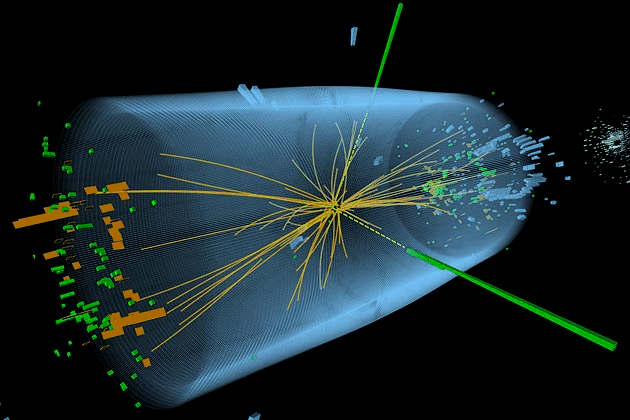
Image Source: http://www.businessweek.com
The term "God Particle" was coined by Leon Lendarman in his book about Higgs Boson. It really is not a GOD particle, it sure is going to be a very important particle that needs to fit the standard model of Physics that we know today. And that by itself is a challenge.
Out of reading elsewhere, I found out that scientists are now evaluating if there are more than one varieties of Higgs Boson particle. If it does, then the scientists will have to re-evaluate our whole standard model of Physics (ie; how do objects gain mass and why do some particles like Photons, do not have mass??). If they find out that there is only one type.. then it could be our answer to the question in bold above. Ie; they will know exactly why stuff happens the way it happens.
Either way it will be interesting to see how things unfold.
Tuesday, September 4, 2012
Voyager - on the verge of exiting Solar System!
Hello fellow Astro-enthusiasts.. found this interesting enough to put it on my blog.
35 years ago tomorrow, Voyager 1 left our Earth and set out on a mission that very few people are aware of. Apart from the fact that Voyager 1 and 2 will be the only man made objects that will have reached the end of our solar system, there are some other interesting facts.
It is interesting to know the kind of equipment that Voyager carried on board in 1977. It just has 68Kb of computer memory!! An 8 track tape recorder.. (Say whaaat!!). Gold plated discs containing multilingual greetings, music and pictures, in a hope that an intelligent species may come across it and be able to decode.

Today Voyager 1 is 11 billion miles away and Voyager 2 is 9 billion miles from the Sun. It takes 17 hours for a radio signal from Voyager 1 to reach earth and 12 hours (or maybe 15 hrs) from Voyager 2.
The news that Voyager exited our Solar System will sure be something I will look out for and milestone to remember and cherish.
Source: yahoo news
35 years ago tomorrow, Voyager 1 left our Earth and set out on a mission that very few people are aware of. Apart from the fact that Voyager 1 and 2 will be the only man made objects that will have reached the end of our solar system, there are some other interesting facts.
It is interesting to know the kind of equipment that Voyager carried on board in 1977. It just has 68Kb of computer memory!! An 8 track tape recorder.. (Say whaaat!!). Gold plated discs containing multilingual greetings, music and pictures, in a hope that an intelligent species may come across it and be able to decode.

Today Voyager 1 is 11 billion miles away and Voyager 2 is 9 billion miles from the Sun. It takes 17 hours for a radio signal from Voyager 1 to reach earth and 12 hours (or maybe 15 hrs) from Voyager 2.
The news that Voyager exited our Solar System will sure be something I will look out for and milestone to remember and cherish.
Source: yahoo news
Saturday, August 25, 2012
Tragic loss - in memory of Neil Armstrong!
In memory of a
legend who passes away today. I decided to write this post for Neil Armstrong
(82). For a man who is so famous, that his name is still studied, and will be
studied in the future, by children all over the world. A man who in everybody's
eyes is a hero and the frontier of space exploration, lived such a normal and
simple life. Thought I should share some interesting facts about him
(Courtesy:TOI)
1. After flying
combat missions during the Korean War, he became a test pilot and joined Nasa's
astronaut program in 1962.
2. As he stepped on
the moon's dusty surface, Armstrong said: "That's one small step for a
man, one giant leap for mankind." obviously we all knew this about him
from our good old text books.
3. Armstrong's pulse
was measured at 150 beats per minute as he guided the lunar lander to the
moon's surface, Nasa said. Asked about his experience on the moon, he told CBS:
"It's an interesting place to be. I recommend it."
4. In 2005 Armstrong
was upset to learn that his barber had sold clippings of his hair to a
collector for $3,000. The man who bought the hair refused to return it, saying
he was adding it to his collection of locks from Abraham Lincoln, Napoleon,
Marilyn Monroe, Albert Einstein and others.
5. Despite his quiet
nature, Armstrong once appeared in a television commercial for the US automaker
Chrysler. He said he made the ad because of Chrysler's engineering history and
his desire to help the company out of financial troubles.
I meant to upload this video (http://youtu.be/gkCxJ4hUhv8) on youtube
for a very long time, but I lazy'ed it until today. Maybe it was meant to be
for this day. I thought I should atleast do this much for a man who did so much
for Mankind. RIP Neil Armstrong. You will be
remembered.
Tuesday, August 7, 2012
One crazy fact about Curiosity's landing on Mars!
Definitely a major milestone in Space exploration. Let me start here by congratulating NASA.
Just in case you did not know:
1. It takes 14 minutes for the signal from the Rover to reach Earth.
2. It takes approximately 7 minutes for the Rover to land on Mars after it touches the Mars atmosphere.
Here goes the crazy fact: By the time, we, on Earth, get the signal from the rover that it has touched the Mars atmosphere, the rover has already landed safely or got destructed somewhere!!
Everything was automatic, with no chance for course correction. With more than 500,000 lines of code and Zero margin of error... Absolutely phenomenal !!
Check out some cool videos on the NASA website:
http://www.nasa.gov/multimedia/videogallery/index.html?collection_id=18895
Credits: www.nasa.gov
Just in case you did not know:
1. It takes 14 minutes for the signal from the Rover to reach Earth.
2. It takes approximately 7 minutes for the Rover to land on Mars after it touches the Mars atmosphere.
Here goes the crazy fact: By the time, we, on Earth, get the signal from the rover that it has touched the Mars atmosphere, the rover has already landed safely or got destructed somewhere!!
Everything was automatic, with no chance for course correction. With more than 500,000 lines of code and Zero margin of error... Absolutely phenomenal !!
Check out some cool videos on the NASA website:
http://www.nasa.gov/multimedia/videogallery/index.html?collection_id=18895
Credits: www.nasa.gov
Friday, March 16, 2012
Moon, like never seen before
Great to be back to write about one of the most photographed object in the night sky... our good old Moon. This video that I saw on space.com is stunning.. so stunning that I HAD to post it..
Staring at the moon for hours together when I was a kid..beautiful! Looking through my telescope at the craters and the shadow formations, imagining the mountains..awesome! But nothing matches what you will see in this video. The more I look at this video.. the more I want to look at it. Okay, enough said, have at it...
Now here is the best part.. This is no Artists imagination... its all real, up close videos and images taken by Nasa's LRO. Be on the look out for more of these, astro enthusiasts.
Courtesy: Space.com
Staring at the moon for hours together when I was a kid..beautiful! Looking through my telescope at the craters and the shadow formations, imagining the mountains..awesome! But nothing matches what you will see in this video. The more I look at this video.. the more I want to look at it. Okay, enough said, have at it...
Now here is the best part.. This is no Artists imagination... its all real, up close videos and images taken by Nasa's LRO. Be on the look out for more of these, astro enthusiasts.
Courtesy: Space.com
Friday, September 23, 2011
Wednesday, September 21, 2011
UARS set for a glorious self destruction
As UARS (Upper Atmosphere Research Satellite) reaches its end of a productive 6 years of research, the world awaits its glorious self destruction as it enters earth's atmosphere on Sep 23rd 2011. It is supposed to enter the Earths atmosphere US time on the 23rd but the exact location is still unknown. As it burns itself while entering the atmosphere, scientists say, it can glow as bright as Venus. Hope to get a glimpse of this historic event.
As Sep 23rd is getting close, NASA is getting a clearer picture as to where this doomed satellite will enter earths atmosphere. Feel free to visit this page for the latest info. http://www.nasa.gov/mission_pages/uars/index.html
Below you can see an Artists image of how it might look from up above.
 I am from Southern California and maybe I am too optimistic, but wish it enters on the west coast and falls in the Pacific Ocean. Its will be a beautiful site to see.
Fingers crossed.
As Sep 23rd is getting close, NASA is getting a clearer picture as to where this doomed satellite will enter earths atmosphere. Feel free to visit this page for the latest info. http://www.nasa.gov/mission_pages/uars/index.html
Below you can see an Artists image of how it might look from up above.
Fingers crossed.
Saturday, June 11, 2011
My first Astro image.
For an amateur astronomer, it’s an Amazing feeling to take my first astro image! I have been trying to take a picture of the moon for quite some time now. Finally I have some success. Believe me guys it’s a treat.
It took me a few months to figure out what the problem was. It was a focal length issue and the webcam image sensor was not able to reach the focal point of my Zhumell 10 inch. I took out the image sensor from the webcam and placed it half way into the eyepiece hole. Luckily, the hole was big enough to accommodate the image circuitry. I taped this arrangement inside the eyepiece to avoid any disturbances. With little adjustments to the eyepiece focusing...BAM! I had the image of the moon.
So for guys who are trying to take a picture of the moon with a webcam and you see that your image is blurry no matter what you do.. You know it’s a focal length issue. Just try to do what I did above and you should be able to get a view. I used wxAstrocapture to record an AVI file and then used Registax 6 to process the image. I know that there are tons of images of the moon out there... but for me this image will always be special.
It took me a few months to figure out what the problem was. It was a focal length issue and the webcam image sensor was not able to reach the focal point of my Zhumell 10 inch. I took out the image sensor from the webcam and placed it half way into the eyepiece hole. Luckily, the hole was big enough to accommodate the image circuitry. I taped this arrangement inside the eyepiece to avoid any disturbances. With little adjustments to the eyepiece focusing...BAM! I had the image of the moon.
So for guys who are trying to take a picture of the moon with a webcam and you see that your image is blurry no matter what you do.. You know it’s a focal length issue. Just try to do what I did above and you should be able to get a view. I used wxAstrocapture to record an AVI file and then used Registax 6 to process the image. I know that there are tons of images of the moon out there... but for me this image will always be special.

 |
| My first astro image! A processed file. |
Specifications of the instruments used:
A Zhumell 10 inch dobsonian (No equitorial mount)
A logitech webcam (CCD sensor, non moded)and A laptop :)
Many more images to follow...
Friday, June 3, 2011
Meteor Lights Up Georgia Sky
A Man-Size Meteor From Comet Lit Up Georgia Sky yesterday...
The 6-foot-wide (1.8-meter) space rock barrelled into Earth's atmosphere at 10:47 p.m. EDT on May 20 (0247 GMT on May 21), about 66 miles (106 kilometers) above the city of Macon, Ga. Two NASA all-sky cameras, both located in northwest Georgia, tracked the resulting meteor and captured it on video.
The 6-foot-wide (1.8-meter) space rock barrelled into Earth's atmosphere at 10:47 p.m. EDT on May 20 (0247 GMT on May 21), about 66 miles (106 kilometers) above the city of Macon, Ga. Two NASA all-sky cameras, both located in northwest Georgia, tracked the resulting meteor and captured it on video.
Just a thought though!
All of this is cool.. But we have advanced so much in space technology that NASA should be able to build a "go getter" space shuttle that goes outside of earths atmosphere, breaks down the meteor and gets a part of the meteor safely down to earth. I am sure that there would have been an era of space history lost when the meteor burned down to ashes, when it entered earths atmosphere.
Yesh.
Posted through my Iphone.
Saturday, May 28, 2011
Bitter Sweet
Bitter Sweet - A term that is being used now a days to descride the current mind-set @ NASA.
After 30 years of spaceflights and more than 130 missions ISS is finally complete. NASA's space shuttle fleet will retire and be on display at institutions across the country to inspire the next generation of explorers and engineers. I am a Californian and its certainly a great news that Endeavour, that will be on its way back to Earth very soon, will be housed here in LA. All mixed feelings...I guess m getting into a bitter sweet mode myself.
- Posted using BlogPress from my iPhone
After 30 years of spaceflights and more than 130 missions ISS is finally complete. NASA's space shuttle fleet will retire and be on display at institutions across the country to inspire the next generation of explorers and engineers. I am a Californian and its certainly a great news that Endeavour, that will be on its way back to Earth very soon, will be housed here in LA. All mixed feelings...I guess m getting into a bitter sweet mode myself.
- Posted using BlogPress from my iPhone
Location:S Pacific St,Oceanside,United States
Tuesday, April 12, 2011
Celebrating 50 Years of Humans in outer Space

Congratulations fellow Astronauts!
It almost feels like there was so less time and we have achieved so much. Yuri Gagarin, made the first orbit of Earth today, 50 years ago. Since then, there was no looking back and man has reached new bounds in outer Space. Bravo!
NGC says "there is something we'll never know about Gagarin's flight, even in the age of Wikileaks: What did the farmer's son from Klushino, Russia, see from 200 miles (322 kilometers) above Earth on April 12, 1961?"
Saturday, March 19, 2011
Moon will NOT eat up Earth tonight!

So really, how big are we talking about here? NASA says the moon will appear 14 percent larger and 30 percent brighter than usual. Moons gravity acts on Earth everyday to cause tides and today will be no different or, will be a day with minimal difference(proably a little higher tides... and thats about it). Thats what NASA says... Anyway, if you see or read stuff like there will be earthquakes or floods or tsunamies... my personal openion... "its just a media hype".
There is no reason to panic. So, rest assured... layback and enjoy the beautiful sight today, as it will not occur again until you have grown at least 20% grey hair in 2029.
Monday, March 7, 2011
Great News. Life found in outer space!
Knew this day was not far..
This is breaking news... and will be evaluated... evaluated... and re-evaluated over the next few days and months, but a NASA scientist, Dr. Richard B. Hoover claims that he has found conclusive evidence of alien life — fossils of bacteria found in an extremely rare class of meteorite. That's an awesome claim.
Below are two pics of the fossils of the bacteria found in the meteorite.

 Dr Hoover says "The exciting thing is that they are in many cases recognizable and can be associated very closely with the generic species here on earth"... which is cool! He further says "There are some that are just very strange and don’t look like anything that I’ve been able to identify, and I’ve shown them to many other experts that have also come up stump."
However, given the controversial nature of this claim, his paper will be examined by hundreds of experts all over the world over the next few days. If this discovery turns out to be true, the implications for human life will be staggering.
Here we come aliens...Oops! too early for that.
Images Courtesy: news.yahoo.com
This is breaking news... and will be evaluated... evaluated... and re-evaluated over the next few days and months, but a NASA scientist, Dr. Richard B. Hoover claims that he has found conclusive evidence of alien life — fossils of bacteria found in an extremely rare class of meteorite. That's an awesome claim.
Below are two pics of the fossils of the bacteria found in the meteorite.

However, given the controversial nature of this claim, his paper will be examined by hundreds of experts all over the world over the next few days. If this discovery turns out to be true, the implications for human life will be staggering.
Here we come aliens...Oops! too early for that.
Images Courtesy: news.yahoo.com
Thursday, February 3, 2011
Apophis, the Planet Killer to Hit Earth in 2036???
Apophis, derived its name from an Egyptian myth, meaning... A demon serpant of darkness.

Here we go again! It was in 2004 when NASA scared the heck out of people and this time its the Russians. Dont take me wrong... All due respect to both the organizations for keeping track of such objects well in advance.
Here is the thing, there is 1 in 250,000 chances that the "Planet Killer" will hit Earth. Its comforting to know however, that in one of the International NEO (Near Earth Objects)meetings in 2005, it was decided that more research needs to be done on how to avoid that "1" chance of impact. Since then there have been numerous ideas on how to avaid that impact.


Here we go again! It was in 2004 when NASA scared the heck out of people and this time its the Russians. Dont take me wrong... All due respect to both the organizations for keeping track of such objects well in advance.
Here is the thing, there is 1 in 250,000 chances that the "Planet Killer" will hit Earth. Its comforting to know however, that in one of the International NEO (Near Earth Objects)meetings in 2005, it was decided that more research needs to be done on how to avoid that "1" chance of impact. Since then there have been numerous ideas on how to avaid that impact.

Just to give you an idea of how large this asteroide is...it is larger than two football fields and cause more damage that 1000 Hiroshimas blown at once!
The asteroid will come really close to the Earth in 1929 and will cause it to change its path by an angle due to Earths gravity. It will continue to rotate around the Sun until it gets back to Earth on April 13, 1936. There is very very little or no chance that it will hit Earth in 1929 but what will happen in 1936 is still a little fuzzy. It seems we will have to wait until 2013 before we get a clearer picture of what will happen then.

There are certainly tons of reports that conflict the probability of such a doomsday event on the internet, but the question remains: How scared should we be?
Images Courtesy: nasa, jpl, msnbc, and space.com
Wednesday, January 26, 2011
Astrophotography with a Dobsonian
I have been surrounded by quite a few interesting things over the last few months. Here is what I have been doing..."Researching" ... Researching on Astrophotography!
Fact: It is not possible to take GREAT pictures with a Dobsonian... Agreed!
Truth: It is possible to take reasonably good pictures with a Dobsonian.
Let me explain...
Astro enthusiasts know this already, that celestial objects are not stationary in the sky... they keep moving... well, not exactly... Earth spins and so it appears as if the celestial objects are moving. In any case it appears as if they are moving. Now, with a dobsonian, one will have to manually adjust and align the object under observation repeatedly... which could be quiet some pain(especially at 300 and above magnifications the objects under observation travel pretty fast).
Concept for equitorial mount: In order to have the object under observation at the center of the viewer... we will have to compensate for the motion of the Earth (Earth rotates from west to east... hence all objects appear to rise from the east and set in the west). Compensation would mean... if we place our telescope on a devise that rotates it in the opposite direction to that of the earth... the earths motion and the telescopes motion will cancel each other and the object of observation will remain "still" at the center of the viewer.
Method: After a lot of research, I found that the equitorial mount will be the best solution. Building this would take a little bit of engineering drawing, little electronics and carpentary. If it sounds hard... well... it is!
By the way... you must be thinking what has Astrophotography got to do with all of this.
Concept for Astrophotography: Taking pictures during night(or on low light) is tough. as the exposure that the camera gets to the light is very less. Low light photography is done using long exposure. There are ways to do this using a ccd webcam(in my case a Logitech QuickcamPro 3000... these CCD webcams are not in production anymore so I bought one on Ebay for $45). You will need to do some modification to the circuit and a little soldering to the webcam circuit board. For a long exposure shot.. the object under observation needs to be focused at the center of the viewer for a long time( 5 sec, 10 sec, 1 min... etc depending on the object). Hence the Equitorial Mount, as it will not be humanly possible to keep the object at the center of the eyepeace manually.
Now-a-days I am trying to build this total setup from various sources available on the internet. It will at-least take me a month or so to complete this whole thing. I plan to do a tutotial with pictures, for those of you who might be interested. Will update my progress on regular basis. Stay tuned and feel free to leave comments.
Clear skies!
Fact: It is not possible to take GREAT pictures with a Dobsonian... Agreed!
Truth: It is possible to take reasonably good pictures with a Dobsonian.
Let me explain...
Astro enthusiasts know this already, that celestial objects are not stationary in the sky... they keep moving... well, not exactly... Earth spins and so it appears as if the celestial objects are moving. In any case it appears as if they are moving. Now, with a dobsonian, one will have to manually adjust and align the object under observation repeatedly... which could be quiet some pain(especially at 300 and above magnifications the objects under observation travel pretty fast).
Concept for equitorial mount: In order to have the object under observation at the center of the viewer... we will have to compensate for the motion of the Earth (Earth rotates from west to east... hence all objects appear to rise from the east and set in the west). Compensation would mean... if we place our telescope on a devise that rotates it in the opposite direction to that of the earth... the earths motion and the telescopes motion will cancel each other and the object of observation will remain "still" at the center of the viewer.
Method: After a lot of research, I found that the equitorial mount will be the best solution. Building this would take a little bit of engineering drawing, little electronics and carpentary. If it sounds hard... well... it is!
By the way... you must be thinking what has Astrophotography got to do with all of this.
Concept for Astrophotography: Taking pictures during night(or on low light) is tough. as the exposure that the camera gets to the light is very less. Low light photography is done using long exposure. There are ways to do this using a ccd webcam(in my case a Logitech QuickcamPro 3000... these CCD webcams are not in production anymore so I bought one on Ebay for $45). You will need to do some modification to the circuit and a little soldering to the webcam circuit board. For a long exposure shot.. the object under observation needs to be focused at the center of the viewer for a long time( 5 sec, 10 sec, 1 min... etc depending on the object). Hence the Equitorial Mount, as it will not be humanly possible to keep the object at the center of the eyepeace manually.
Now-a-days I am trying to build this total setup from various sources available on the internet. It will at-least take me a month or so to complete this whole thing. I plan to do a tutotial with pictures, for those of you who might be interested. Will update my progress on regular basis. Stay tuned and feel free to leave comments.
Clear skies!
Tuesday, November 9, 2010
Tips for looking through a telescope
Last weekend was the first time I was looking through my telescope. I had to drive 2 Hrs to get to a star party. It was fun looking at the amazing stuff people had. I looked at Jupiter(my first object through my Zhumell 10 inch) and the Orion nebule.
I knew all my theoretical stuff.. how to read a sky map? What is altitude and Azmuth? How to focus on an object and things like that... but I bet there are tons of other things that you will learn when you are actually operating the scope. Here are a few tips for people who are looking through their telescopes for the first time:
1. To start with... Always, colliminate your scope before you start. That is because when you are setting up your scope(or during logistics), chances are that the collimination is lost.
2. Find your object using the "finder scope". Next...start with the lowest magnification(say 35mm). Bring the object of observation to the center of the screen and adjuct the focus using your eyepiece. You could now, increase the magnification to the next level(say 12.5mm)... your view through the scope might not be in the center now and might be blurry. You now need to get it to the center of the screen again and focus it. You are now ready to increase it to the next magnification(say 6mm or 4mm). You need to now again bring it back to the center of the screen and re-focus it.
Note: One important thing here is to bring the image to the near perfect center of your view. Because when you go from magnification 12.5mm to 6mm or 4 mm... you are going from 96X magnification to 300X magnification. So, if the image is not in the near perfect center, you might loose the image in the 300X view.
I knew all my theoretical stuff.. how to read a sky map? What is altitude and Azmuth? How to focus on an object and things like that... but I bet there are tons of other things that you will learn when you are actually operating the scope. Here are a few tips for people who are looking through their telescopes for the first time:
1. To start with... Always, colliminate your scope before you start. That is because when you are setting up your scope(or during logistics), chances are that the collimination is lost.
2. Find your object using the "finder scope". Next...start with the lowest magnification(say 35mm). Bring the object of observation to the center of the screen and adjuct the focus using your eyepiece. You could now, increase the magnification to the next level(say 12.5mm)... your view through the scope might not be in the center now and might be blurry. You now need to get it to the center of the screen again and focus it. You are now ready to increase it to the next magnification(say 6mm or 4mm). You need to now again bring it back to the center of the screen and re-focus it.
Note: One important thing here is to bring the image to the near perfect center of your view. Because when you go from magnification 12.5mm to 6mm or 4 mm... you are going from 96X magnification to 300X magnification. So, if the image is not in the near perfect center, you might loose the image in the 300X view.
Wednesday, October 27, 2010
My gateway to the Heavens!!

Good news - Its a 10 inch, so it has got a lot of light gathering capacity... hope to get some nice views of our moon, Jupiter, some nebula and a few galaxies.
Bad news - Its a Dobsonian... does not have an equatorial mount. Since the relative position of stars, planets and our Earth keeps changing, tracking though this telescope would be tough. Taking pictures is almost impossible.
Bottom line - Great telescope for starter amateur astronomers.
Clear Skies!
Sunday, October 3, 2010
Opportunity's latest picture of Mars

This image from the navigation camera on NASA's Mars Exploration Rover "Opportunity" shows surroundings of the rover's location following an 81-meter (266-foot) drive during the 2,363rd Martian day, or sol, of Opportunity's mission on Mars (that was as of Sept. 16, 2010). The terrain includes light-toned bedrock and darker ripples of wind-blown sand. Today it is the 2380th Martian day. By the way a Sol means Solar day.
FYI - 1 year on Mars in around 668 Sols.
Source: nasa.gov
Friday, October 1, 2010
Life on Alien Planet near Earth???
This is in continuation to my previous blog... Help yourself reading my previous blog too.
One of the planet's discoverers said in a briefing yesterday that "the chances of life on this planet(Gliese 581g) are 100 percent." How do we prove this? Scientists say there are several ways, but the best approach is as simple as "Listening for signals". This planet is 20.5 light years away from Earth, so human built probes won't be getting out there anytime soon :) By the way a light year is the distance traveled by light in 1 year.
One of the planet's discoverers said in a briefing yesterday that "the chances of life on this planet(Gliese 581g) are 100 percent." How do we prove this? Scientists say there are several ways, but the best approach is as simple as "Listening for signals". This planet is 20.5 light years away from Earth, so human built probes won't be getting out there anytime soon :) By the way a light year is the distance traveled by light in 1 year.
Subscribe to:
Posts (Atom)