A Quote by Sir Martin Rees, Astronomer Royal of Great Britain


Telescopes are in some ways like time machines...
They reveal galaxies so far away that their light has taken billions of years to reach us. We in astronomy have an advantage in studying the universe, in that we can actually see the past. We owe our existence to stars, because they make the atoms of which we are formed. So if you are romantic you can say we are literally starstuff. If you're less romantic you can say we're the nuclear waste from the fuel that makes stars shine. We've made so many advances in our understanding. A few centuries ago, the pioneer navigators learnt the size and shape of our Earth, and the layout of the continents. We are now just learning the dimensions and ingredients of our entire cosmoc, and can at last make some sense of our cosmic habitat.


Latest in Space - Top Stories

Friday, November 13, 2009

Its Official... Water found on Moon.

So finally after intensive study of the data collected from three different spacecrafts, NASA confirms the presence of Water on lunar surface. The findings of all three spacecrafts, Indias Chandrayaan-I, Cassini and the Deep Impact Spacecraft provide unambiguous evidence of the presence of water.


So how on this heavenly Earth(or should I say Moon) did this Water come from!!!

Per NASA, there is a potential for two types of water on the Moon.

Type 1: That was brought from outside sources, like water-bearing comets striking the lunar surface.
Type 2: Interaction of Solar winds with lunar rocks.


Type 2 explained: Rocks that make up lunar surface are 45% Oxygen combined with other silicate materials. The Solar wind is made up of protons and/or positively charged Hydrogen atoms. When the constant stream of solar particles emitted by the Sun travelling at 1/3rd the speed of light hit the lunar surface with enough force they break apart already existing oxygen bonds in the lunar soil and tend to form water.

Bottom line: GREAT news! H2O found on Moon.


Courtesy: nasa.gov

Friday, October 9, 2009

LCROSS impacts the moon

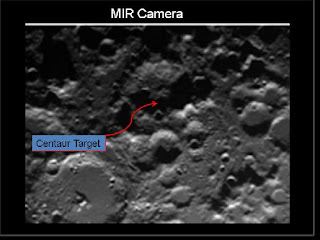
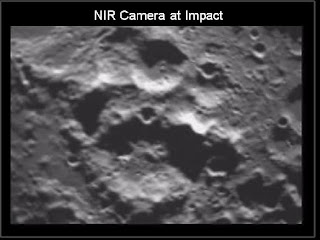
Its been a wonderful night for me, watching the LCROSS hit the moon. Obviously I could not see the actual impact(nobody could have), but I saw the images taken by cameras onbord LCROSS while it was approacing the lunar surface. It was a beautiful sight.

NASA selected the impact site to be a shadowed region in a crator on the moons south pole. The logic behind this selection for impact is... possible abundance of water or water ice molecules(is any). Why is there a need to search for water on the moon? Finding natural resources, such as water ice, on the moon could help expedite lunar exploration. By going to the moon for extended periods of time, a new generation of explorers will learn how to work safely in a harsh environment. A lunar outpost is a stepping stone to future exploration of other bodies in our solar system. The moon also offers many clues about when the planets were formed.
Over the next 10 or so days NASA will study the large amounts of data collected during the mission and declare if or not there is water or water ice on the moon.


I am posting one or two closeup shots of the moon taken by LCROSS. Hope to see more!

Clear Skys...
Image Courtesy: www.nasa.gov

Wednesday, September 23, 2009

Indias Chandrayaan along with NASA finds water on Moon

India's first moon mission has found water on the moon. The credit goes to one of the scientific instruments(Known as M3 - Moon Minerology Mapper) owned by NASA. This instrument was on-board Chandrayaan. Sniffing for water on the moon was one of the main objectives of the mission said Dr Mylswamy Annadurai, the project director of Chandrayaan-1.

The Moon mapper also made the unexpected discovery that water may still be forming on the surface of the Moon, according to scientists familiar with the mission.

Though it may take time, but this, I feel, would trigger a series of moon missions for India. Today I am a very proud Indian congratulating the whole Chandrayaan-I team at ISRO. Looking fwd for an Indian manned moon mission.

Thursday, September 17, 2009

Hubble is back in business.

NASA's Hubble Space Telescope is back in business, ready to uncover new worlds, peer ever deeper into space, and even map the invisible backbone of the universe. The first snapshots from the refurbished Hubble showcase the 19-year-old telescope's new vision. Topping the list of exciting new views are colorful multi-wavelength pictures of far-flung galaxies, a densely packed star cluster, an eerie "pillar of creation," and a "butterfly" nebula. With its new imaging camera, Hubble can view galaxies, star clusters, and other objects across a wide swath of the electromagnetic spectrum, from ultraviolet to near-infrared light.
Here are a few samples of what the upgraded Hubble can do...


Tuesday, June 23, 2009

NASA Probe Orbits Moon

A NASA spacecraft has started its one-year mission to map the moon.

The Lunar Reconnaissance Orbiter entered the moon's orbit early Tuesday following a four-and-a-half day journey from earth, the space agency said.


The LRO will perform a series of four engine burns over the next four days to position itself for a "commissioning phase" orbit, during which time its seven onboard instruments will be brought online and checked out by engineers.


The LRO will transition to its primary mission orbit—about 31 miles above the moon--about 60 days later, according to NASA.


For the next year, the LRO will use an array of scanners and tools to create 3D, high-resolution maps of the lunar surface while peering into some of the darkest corners of earth's closest celestial neighbor.


NASA said it expects the LRO to return more data about the moon than any previous mission.


Monday, April 6, 2009

Cassinis flyby images and videos


Though I expected better pictures of Saturn, looking at these pictures and the videos was exciting too. I guess I was expecting a little too much :)


The new flyover maps show, for the first time, the 3-D topography and height of the 1,200-meter (4,000-foot) mountain tops, the north polar lake country, the vast dunes more than 100 meters (300 feet) high that crisscross the moon, and the thick flows that may have oozed from possible ice volcanoes.

Here are the links to the Videos of the 3-D terrain.


Source: jpl.nasa.org

Thursday, April 2, 2009

Cassinis Equinox Mission (Flyby - 19 hrs from now)


Cassini is another NASA mission and it completed its initial four-year’s of exploring the Saturn System. Now, the healthy spacecraft is working overtime on the Cassini Equinox Mission, seeking answer to new questions raised in Cassini’s first years at Saturn. It initially observed the southern hemisphere of Saturn and now its set to observe the Northen side. In August 2009 when the sun will shine directly on the equator and then begin to illuminate the northern hemisphere and the rings’ northern face, Cassini will observe seasonal changes brought by the changing Suns angle on Saturn, its Rings and its Moons, which were illuminated from the south during the mission’s first four years.

Many repeat visits(flybys) are planned for Cassini at the moons Titan and Enceladus – both important targets of the Equinox Mission. Cassinis next encounter with Titan is in about 19 hrs from now. Looking forward for a few Titan pictures!


Courtesy: jpl.nasa.gov